MuleSoft-Integration-Architect-I Actual Questions | MuleSoft-Integration-Architect-I Training Kit
Wiki Article
P.S. Free & New MuleSoft-Integration-Architect-I dumps are available on Google Drive shared by PrepAwayTest: https://drive.google.com/open?id=18_mb644LUChBTOm2Py23A2LyC_PJ3VmP
You can access our web-based copyright Certified MuleSoft Integration Architect I (MuleSoft-Integration-Architect-I) practice exam from anywhere with an internet connection, and fit your studying into your busy schedule. No more traveling to a physical classroom, wasting time and money on gas or public transportation. With the web-based copyright MuleSoft-Integration-Architect-I Practice Test, you can evaluate and enhance your progress. Customizable web-based mock exam creates a real copyright Certified MuleSoft Integration Architect I (MuleSoft-Integration-Architect-I) exam environment and works on all operating systems.
copyright MuleSoft-Integration-Architect-I Exam Syllabus Topics:
| Topic | Details |
|---|---|
| Topic 1 |
|
| Topic 2 |
|
| Topic 3 |
|
| Topic 4 |
|
| Topic 5 |
|
| Topic 6 |
|
| Topic 7 |
|
>> MuleSoft-Integration-Architect-I Actual Questions <<
MuleSoft-Integration-Architect-I Training Kit - Authorized MuleSoft-Integration-Architect-I Pdf
As we all know, there are many reasons for the failure of the MuleSoft-Integration-Architect-I exam, such as chance, the degree of knowledge you master. Although the MuleSoft-Integration-Architect-I exam is an exam to test your mastery of the knowledge of MuleSoft-Integration-Architect-I, but there are so many factor to influence the result. As long as you choose our MuleSoft-Integration-Architect-I exam materials, you never have to worry about this problem. Because we will provide you a chance to replace other exam question bank if you didn’t pass the MuleSoft-Integration-Architect-I Exam at once. What’s more important it’s that also free of charge only if you provide relevant proof. It is very convenient to replace and it's not complicated at all. It will not cause you any trouble.
copyright Certified MuleSoft Integration Architect I Sample Questions (Q190-Q195):
NEW QUESTION # 190
Mule application A receives a request Anypoint MQ message REQU with a payload containing a variable-length list of request objects. Application A uses the For Each scope to split the list into individual objects and sends each object as a message to an Anypoint MQ queue.
Service S listens on that queue, processes each message independently of all other messages, and sends a response message to a response queue.
Application A listens on that response queue and must in turn create and publish a response Anypoint MQ message RESP with a payload containing the list of responses sent by service S in the same order as the request objects originally sent in REQU.
Assume successful response messages are returned by service S for all request messages.
What is required so that application A can ensure that the length and order of the list of objects in RESP and REQU match, while at the same time maximizing message throughput?
- A. Keep track of the list length and all object indices in REQU, both in the For Each scope and in all communication involving service Use persistent storage when creating RESP
- B. Use an Async scope within the For Each scope and collect response messages in a second For Each scope in the order In which they arrive, then send RESP using this list of responses
- C. Perform all communication involving service S synchronously from within the For Each scope, so objects in RESP are in the exact same order as request objects in REQU
- D. Use a Scatter-Gather within the For Each scope to ensure response message order Configure the Scatter-Gather with a persistent object store
Answer: A
Explanation:
Correct answer is Perform all communication involving service S synchronously from within the For Each scope, so objects in RESP are in the exact same order as request objects in REQU : Using Anypoint MQ, you can create two types of queues: Standard queue These queues don't guarantee a specific message order. Standard queues are the best fit for applications in which messages must be delivered quickly. FIFO (first in, first out) queue These queues ensure that your messages arrive in order. FIFO queues are the best fit for applications requiring strict message ordering and exactly-once delivery, but in which message delivery speed is of less importance Use of FIFO queue is no where in the option and also it decreased throughput. Similarly persistent object store is not the preferred solution approach when you maximizing message throughput. This rules out one of the options. Scatter Gather does not support ObjectStore. This rules out one of the options. Standard Anypoint MQ queues don't guarantee a specific message order hence using another for each block to collect response wont work as requirement here is to ensure the order. Hence considering all the above factors the feasible approach is Perform all communication involving service S synchronously from within the For Each scope, so objects in RESP are in the exact same order as request objects in REQU
NEW QUESTION # 191
What requires configuration of both a key store and a trust store for an HTTP Listener?
- A. Encryption of both HTTP request header and HTTP request body for all HTTP clients
- B. Encryption of both HTTP request and HTTP response bodies for all HTTP clients
- C. Encryption of requests to both subdomains and API resource endpoints fhttPs://aDi.customer.com/ and https://customer.com/api)
- D. Support for TLS mutual (two-way) authentication with HTTP clients
Answer: D
Explanation:
1 way SSL : The server presents its certificate to the client and the client adds it to its list of trusted certificate. And so, the client can talk to the server.
2-way SSL: The same principle but both ways. i.e. both the client and the server has to establish trust between themselves using a trusted certificate. In this way of a digital handshake, the server needs to present a certificate to authenticate itself to client and client has to present its certificate to server.
* TLS is a cryptographic protocol that provides communications security for your Mule app.
* TLS offers many different ways of exchanging keys for authentication, encrypting data, and guaranteeing message integrity Keystores and Truststores Truststore and keystore contents differ depending on whether they are used for clients or servers:
For servers: the truststore contains certificates of the trusted clients, the keystore contains the private and public key of the server. For clients: the truststore contains certificates of the trusted servers, the keystore contains the private and public key of the client.
Adding both a keystore and a truststore to the configuration implements two-way TLS authentication also known as mutual authentication.
* in this case, correct answer is Support for TLS mutual (two-way) authentication with HTTP clients.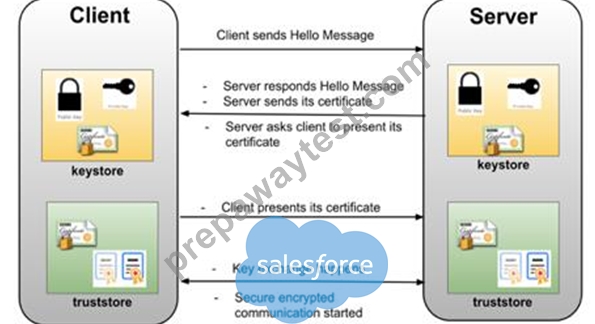
NEW QUESTION # 192
What is the MuleSoft-recommended best practice to share the connector and configuration information among the APIs?
- A. Build another System API that connects to the database, and refactor all the other APIs to make requests through the new System API to access the database
- B. Create an API proxy for each System API and share the Database connector configuration with all the API proxies via an automated policy
- C. Build a separate Mule domain project for each API, and configure each of them to use a file on a shared file store to load the configuration information dynamically
- D. Build a Mule domain project, add the Database connector and configuration to it, and reference this one domain project from each System API
Answer: D
Explanation:
The MuleSoft-recommended best practice for sharing the connector and configuration information among multiple APIs is to use a Mule domain project. The steps are:
* Create a Mule domain project.
* Add the Database connector and its configuration to the domain project.
* Reference this domain project from each System API that needs to use the Database connector and configuration.
By using a domain project, you centralize the configuration and reuse it across multiple APIs. This approach ensures consistency, reduces duplication, and simplifies maintenance and updates to the connector configuration.
References
* MuleSoft Documentation on Domain Projects
* Best Practices for Reusable Configuration in MuleSoft
NEW QUESTION # 193
As a part of project requirement, Java Invoke static connector in a mule 4 application needs to invoke a static method in a dependency jar file. What are two ways to add the dependency to be visible by the connectors class loader?
(Choose two answers)
- A. Add the dependency jar file to the java classpath by setting the JVM parameters
- B. Use Maven command to include the dependency jar file when packaging the application
- C. Configure the dependency as a shared library in the project POM
- D. Update mule-artefact.json to export the Java package
- E. In the Java Invoke static connector configuration, configure a path and name of the dependency jar file
Answer: B,C
Explanation:
To ensure that the Java Invoke static connector in a Mule 4 application can access a static method in a dependency jar file, you need to make the dependency visible to the connector's class loader. Here are the two effective methods to achieve this:
* Using Maven Command:
* Include Dependency via Maven: Add the dependency jar file using Maven when packaging the Mule application. This ensures that the jar file is included in the application's build and is available at runtime.
* Add the dependency to your pom.xml file:
<dependency> <groupId>com.example</groupId> <artifactId>example-library</artifactId> <version>1.0.0<
/version> </dependency>
* Use the Maven package command to build the application and include the dependency:
mvn clean package
* Configuring Dependency as a Shared Library:
* Shared Library Configuration: Configure the dependency as a shared library in the project POM.
This makes the jar available to all components within the Mule application.
* Define the shared library in pom.xml:
xml
<dependency> <groupId>com.example</groupId> <artifactId>example-library</artifactId> <version>1.0.0<
/version> <scope>provided</scope> </dependency>
* Steps for Java Invoke Configuration:
* Ensure the static method in the dependency jar file is accessible via the Java Invoke connector by correctly configuring the connector with the class and method details.
* Benefits:
* Maven Integration: Using Maven ensures that the dependency management is streamlined and integrated with the build lifecycle of the Mule application.
* Shared Library: Configuring as a shared library ensures that the dependency is managed centrally and is easily accessible by various parts of the Mule application.
References:
* MuleSoft Documentation on Java Module
* Maven Documentation on Dependency Management
NEW QUESTION # 194
49 of A popular retailer is designing a public API for its numerous business partners. Each business partner will invoke the API at the URL 58. https://api.acme.com/partnefs/vl. The API implementation is estimated to require deployment to 5 CloudHub workers.
The retailer has obtained a public X.509 certificate for the name apl.acme.com, signed by a reputable CA, to be used as the server certificate.
Where and how should the X.509 certificate and Mule applications be used to configure load balancing among the 5 CloudHub workers, and what DNS entries should be configured in order for the retailer to support its numerous business partners?
- A. Add the X.509 certificate to the CloudHub Shared Load Balancer (SLB), not to the Mule application Create a CNAME for api.acme.com pointing to the SLB's A record
- B. Add the X.509 certificate to a CloudHub Dedicated Load Balancer (DLB), not to the Mule application Create a CNAME for api.acme.com pointing to the DLB's A record
- C. Add the X.509 certificate to the Mule application's deployable archive, then configure a CloudHub Dedicated Load Balancer (DLB) for each of the Mule application's CloudHub workers Create a CNAME for api.acme.com pointing to the DLB's A record
- D. Add the x.509 certificate to the Mule application's deployable archive, then configure the CloudHub Shared Load Balancer (SLB) for each of the Mule application's CloudHub workers
Answer: B
Explanation:
Create a CNAME for api.acme.com pointing to the SLB's A record
Explanation:
* An X.509 certificate is a vital safeguard against malicious network impersonators. Without x.509 server authentication, man-in-the-middle attacks can be initiated by malicious access points, compromised routers, etc.
* X.509 is most used for SSL/TLS connections to ensure that the client (e.g., a web browser) is not fooled by a malicious impersonator pretending to be a known, trustworthy website.
* Coming to the question , we can not use SLB here as SLB does not allow to define vanity domain names. * Hence we need to use DLB and add certificate in there
--------------------------------------------------------------------------------------------------------------------- Hence correct answer is Add the X 509 certificate to the cloudhub Dedicated Load Balancer (DLB), not the Mule application. Create the CNAME for api.acme.com pointing to the DLB's record
NEW QUESTION # 195
......
The MuleSoft-Integration-Architect-I certificate is the bridge between "professional" and "unprofessional", and it is one of the ways for students of various schools to successfully enter the society and embark on an ideal career. It is also one of the effective ways for people in the workplace to get more opportunities. But few people can achieve it for the limit of time or other matters. But with our MuleSoft-Integration-Architect-I Exam Questions, it is as easy as pie. Just buy our MuleSoft-Integration-Architect-I training guide, then you will know how high-effective it is!
MuleSoft-Integration-Architect-I Training Kit: https://www.prepawaytest.com/copyright/MuleSoft-Integration-Architect-I-practice-exam-dumps.html
- Marvelous copyright MuleSoft-Integration-Architect-I Actual Questions With Interarctive Test Engine - Authoritative MuleSoft-Integration-Architect-I Training Kit ???? Download ➥ MuleSoft-Integration-Architect-I ???? for free by simply searching on ➤ www.prepawayete.com ⮘ ◀Test MuleSoft-Integration-Architect-I Passing Score
- New MuleSoft-Integration-Architect-I Test Materials ???? MuleSoft-Integration-Architect-I Printable PDF ???? MuleSoft-Integration-Architect-I Exam Dumps Provider ???? Easily obtain free download of ➥ MuleSoft-Integration-Architect-I ???? by searching on ▶ www.pdfvce.com ◀ ????MuleSoft-Integration-Architect-I Latest Dumps Questions
- Trustworthy MuleSoft-Integration-Architect-I Exam Torrent ???? Valid MuleSoft-Integration-Architect-I Exam Voucher ???? Test MuleSoft-Integration-Architect-I Passing Score ???? The page for free download of 【 MuleSoft-Integration-Architect-I 】 on ➠ www.practicevce.com ???? will open immediately ????Test MuleSoft-Integration-Architect-I Passing Score
- MuleSoft-Integration-Architect-I Actual Questions | High-quality copyright Certified MuleSoft Integration Architect I 100% Free Training Kit ???? ( www.pdfvce.com ) is best website to obtain 【 MuleSoft-Integration-Architect-I 】 for free download ????Trustworthy MuleSoft-Integration-Architect-I Exam Torrent
- copyright MuleSoft-Integration-Architect-I PDF Questions-Shortcut To Success ???? ⏩ www.easy4engine.com ⏪ is best website to obtain ( MuleSoft-Integration-Architect-I ) for free download ????Vce MuleSoft-Integration-Architect-I Test Simulator
- Hot MuleSoft-Integration-Architect-I Actual Questions | Professional MuleSoft-Integration-Architect-I: copyright Certified MuleSoft Integration Architect I 100% Pass ???? Open ▛ www.pdfvce.com ▟ enter ▛ MuleSoft-Integration-Architect-I ▟ and obtain a free download ????MuleSoft-Integration-Architect-I Test Preparation
- MuleSoft-Integration-Architect-I Study Test ???? Reliable MuleSoft-Integration-Architect-I Exam Guide ???? MuleSoft-Integration-Architect-I Latest Dumps Questions ???? Search for ▛ MuleSoft-Integration-Architect-I ▟ and download it for free on ⇛ www.torrentvce.com ⇚ website ↙MuleSoft-Integration-Architect-I Verified Answers
- Practice MuleSoft-Integration-Architect-I Test ???? Trustworthy MuleSoft-Integration-Architect-I Exam Torrent ???? New MuleSoft-Integration-Architect-I Test Materials ???? Search for ➽ MuleSoft-Integration-Architect-I ???? and download it for free immediately on ▛ www.pdfvce.com ▟ ????MuleSoft-Integration-Architect-I Study Test
- copyright MuleSoft-Integration-Architect-I PDF Questions-Shortcut To Success ???? Easily obtain free download of ⮆ MuleSoft-Integration-Architect-I ⮄ by searching on “ www.testkingpass.com ” ????MuleSoft-Integration-Architect-I Verified Answers
- Hot MuleSoft-Integration-Architect-I Actual Questions | Professional MuleSoft-Integration-Architect-I: copyright Certified MuleSoft Integration Architect I 100% Pass ???? Search for ✔ MuleSoft-Integration-Architect-I ️✔️ and obtain a free download on ▷ www.pdfvce.com ◁ ℹValid MuleSoft-Integration-Architect-I Exam Voucher
- MuleSoft-Integration-Architect-I Test Preparation ✔️ MuleSoft-Integration-Architect-I Printable PDF ???? Reliable MuleSoft-Integration-Architect-I Exam Guide ???? Open website ➤ www.prepawaypdf.com ⮘ and search for ☀ MuleSoft-Integration-Architect-I ️☀️ for free download ????MuleSoft-Integration-Architect-I Study Test
- tegankexf201954.activablog.com, shaunasbbv660255.izrablog.com, topdirectory1.com, www.stes.tyc.edu.tw, antoniqov885372.daneblogger.com, carlyqsor581529.iyublog.com, wiishlist.com, www.stes.tyc.edu.tw, gurudaksh.com, frasergpzg075034.blogvivi.com, Disposable vapes
BONUS!!! Download part of PrepAwayTest MuleSoft-Integration-Architect-I dumps for free: https://drive.google.com/open?id=18_mb644LUChBTOm2Py23A2LyC_PJ3VmP
Report this wiki page